The Best Fluffy Pancakes recipe you will fall in love with. Full of tips and tricks to help you make the best pancakes.

Business Intelligence Systems Built for Strategic Decision-Making
Quik Analytic designs structured Business Intelligence systems that transform distributed operational data into executive clarity. We enable leadership teams to move beyond fragmented reporting and toward aligned, measurable decision frameworks.
Schedule Strategy Call →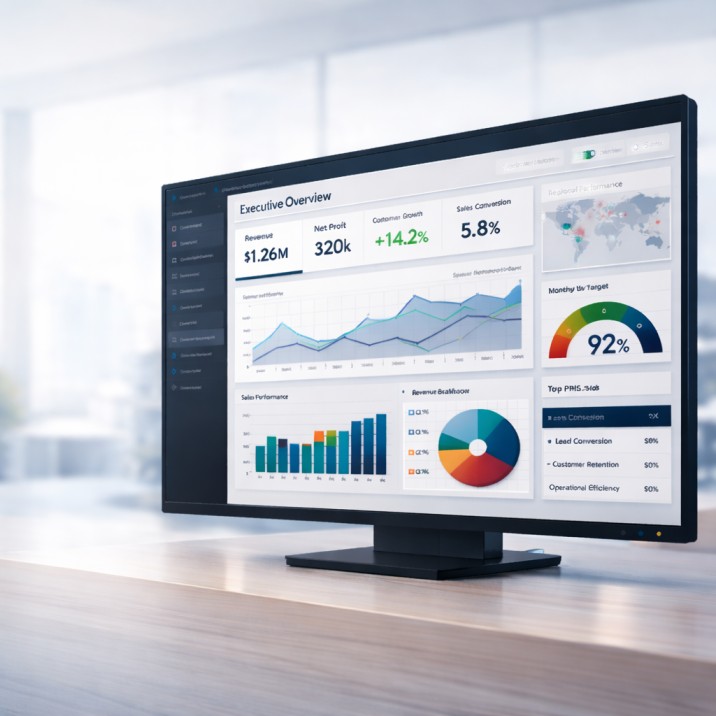
The Challenge
Most Organizations Have Data. Few Have Structured Intelligence.
Data Exists Across Disconnected Systems
Marketing platforms, CRM tools, finance systems, operational software, and spreadsheets operate independently. Visibility remains fragmented across departments.
No Centralized Performance View
Leadership teams lack a unified dashboard that consolidates performance indicators into a single, structured reporting environment.
KPI Misalignment Across Functions
Departments measure performance differently. Metrics are tracked, but not strategically aligned to enterprise-level objectives.
Decision-Making Without Structured Reporting
Without executive-grade reporting architecture, strategic decisions rely on partial analysis and manual interpretation.
Operational Data Without Governance Creates Strategic Blind Spots
The issue is not a lack of information. It is the absence of structured intelligence architecture. When performance data is not centralized, validated, and aligned with strategic objectives, organizations operate reactively instead of proactively.
Business Intelligence is not about dashboards alone — it is about enabling disciplined, evidence-based leadership.
What We Build
Structured Intelligence Systems Designed for Executive Oversight
Centralized Dashboard Systems
We architect unified performance dashboards that consolidate marketing, finance, operations, and sales data into a single source of truth.
KPI Architecture & Performance Frameworks
Strategic KPI models aligned with revenue, profitability, and operational efficiency — ensuring measurable accountability across functions.
Executive Reporting Models
Board-level reporting structures designed for clarity, precision, and actionable insight — eliminating reporting noise.
Data Integration & Visualization
Seamless integration of CRM systems, ERP platforms, marketing tools, and financial software into structured visualization environments.
Real-Time Performance Monitoring
Live performance tracking systems enabling leadership teams to transition from reactive management to proactive decision-making.
Our Intelligence Framework
A Structured Methodology for Executive-Level Business Intelligence
01
Define Strategic KPIs
We align with leadership to define performance indicators directly tied to revenue growth, profitability, and operational efficiency. Every metric must support measurable strategic objectives.
02
Map Data Sources
All relevant data environments — CRM, ERP, marketing platforms, finance systems — are mapped, validated, and structured to ensure reporting accuracy.
03
Build Reporting Architecture
We design scalable dashboard hierarchies that serve executive, managerial, and operational layers without duplicating effort or creating reporting noise.
04
Enable Decision Clarity
The final system provides centralized, structured visibility — enabling disciplined, evidence-based leadership decisions across the organization.
Who This Is For
Designed for Organizations That Prioritize Structured Performance Governance
Leadership Teams
Organizations seeking structured, enterprise-level visibility across departments to enable disciplined performance governance.
CEOs & Founders
Decision-makers requiring consolidated executive dashboards that provide clarity without operational complexity.
Performance-Focused Organizations
Companies committed to measurable growth, KPI accountability, and data-backed operational oversight.
Scaling Enterprises
Businesses expanding operations that require standardized reporting architecture to maintain control and strategic alignment.
Business Impact
From Fragmented Reporting to Structured Strategic Intelligence
Before
- Scattered reports across multiple tools and spreadsheets
- Reactive decision-making based on partial visibility
- KPI inconsistencies between departments
- Manual data compilation and reporting delays
- Unclear accountability at the leadership level
After
- Unified dashboards serving as a single source of truth
- Aligned KPI frameworks across departments
- Real-time performance visibility for leadership
- Structured reporting architecture with governance
- Disciplined, evidence-based strategic decision-making
Move From Data Visibility to Strategic Intelligence
Implement a structured Business Intelligence system designed to support executive-level governance, performance alignment, and evidence-based decision-making.
Schedule Strategy Call →